%20%20-%20Menu.svg)








In this blog
TL/DR: Summary
AI in ecommerce customer service requires live carrier and order data integration to resolve WISMO queries, the single highest-volume post-purchase support category.
-
WISMO tickets dominate ecommerce support queues because documentation-only bots cannot access real-time carrier scan data, resulting in unresolved loops.
-
The global AI customer service market is projected to reach $15.6 billion in 2026, growing at a 23.2% annual rate, per Grand View Research.
-
Gartner estimates AI agents will autonomously resolve 80% of common service issues by 2029, cutting operational costs by roughly 30%.
-
PwC's 2025 Customer Experience Survey found 29% of consumers stopped buying from a brand following a single poor service interaction.
-
Proactive shipment exception alerts, delivered before customers ask, convert potential refund requests into retained customers by eliminating reactive WISMO contact.
When someone messages your store asking where their order is, they're rarely just curious. They paid, they've been waiting, and the silence is starting to feel like something went wrong.
It's the most common question in ecommerce support by a wide margin, and the one most customer service AI handles the worst. A bot can know your entire help center by heart and still leave that person no calmer, because what they're really asking, where is my parcel right now, was never written down anywhere.
This is where a lot of well-meaning advice falls short. Most writing on AI in customer service comes from software companies and SaaS help desks, where answering well means reading the documentation and replying with care. Commerce doesn't work that way.
Your busiest question has no fixed answer to look up. It changes every time a carrier scans the parcel, so the truth lives in your order and tracking systems, not your help articles. Connect your AI only to the help center and it's ready for everything except the question your customers and agents are most worn down by.
This guide is written from inside that problem, not above it. ClickPost's shipment intelligence layer handles more than 50 million orders a month for brands like Puma, Adidas, Oriflame, and The Body Shop, so everything here comes from real post-purchase traffic, not a tidy market overview.
Why ecommerce AI customer service is its own discipline
The market math is settled. The global AI customer service market is expected to reach roughly $15.6 billion in 2026, growing at about a 23.2% annual rate, per Grand View Research data cited widely across the industry. Gartner expects AI agents to autonomously resolve around 80% of common service issues by 2029, cutting operational costs by roughly 30%. McKinsey data puts the near-term effect at a 40 to 50 percent reduction in service interactions. Every one of these numbers says the same thing. Adoption is settled, and what counts now is whether the AI can resolve the one question your help center never could.
That question even has a name on support teams: WISMO, short for "where is my order." It's already the biggest ticket category most stores see, and every one of them is a moment the relationship can quietly turn.
PwC's 2025 Customer Experience Survey found that 29% of consumers have stopped buying from a brand after a poor service experience. A delayed parcel met with a vague reply is exactly that. So a WISMO message isn't only a cost to clear off the queue, it's a loyalty decision your customer is quietly making while they wait.
Here's the structural problem most generic tools never confront: this queue can't be answered from documentation. The answer lives in three systems: the order management system, the warehouse status, and the live carrier feed. In most stacks, none of them talk to the support tool. So the agent, human or AI, sifts through tabs. Handle time balloons. The customer waits for a fact that a machine should have surfaced instantly. An AI that only reads your help center will paraphrase your shipping policy. It will not tell Maya her parcel cleared the Mumbai hub at 6 a.m. and is out for delivery.
In SaaS, the source of truth is a help article. In commerce, the source of truth is a carrier scan. Build your AI for the wrong one, and it stalls on the most common question you get.
How ecommerce AI customer service actually works: the four data layers
Strip away the marketing, and an ecommerce support agent is only as good as the data it can reach and the actions it's allowed to take. There are four layers, and most disappointing deployments are missing two of them.
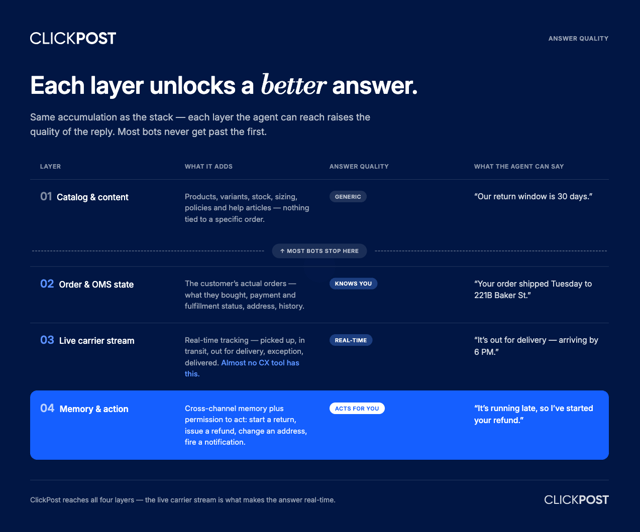
The principle that ties them together is grounding. The agent answers only from what it can verify in these layers, and says so when it can't. An agent that invents a delivery date to seem helpful is worse than one that says "let me get a human." That's why the data layers aren't optional plumbing. They're the difference between confident truth and confident fiction.
Chatbot vs. agentic AI: the distinction that matters
"AI agent" and "chatbot" get used interchangeably, and the confusion costs brands real money. The line isn't conversational polish. It's an autonomous action. As Salesforce frames it, a chatbot follows rules-based dialogue and points you to information. An AI agent connects to your data, assesses the request, and completes the task without manual intervention. Put bluntly: chatbots respond, agents resolve.
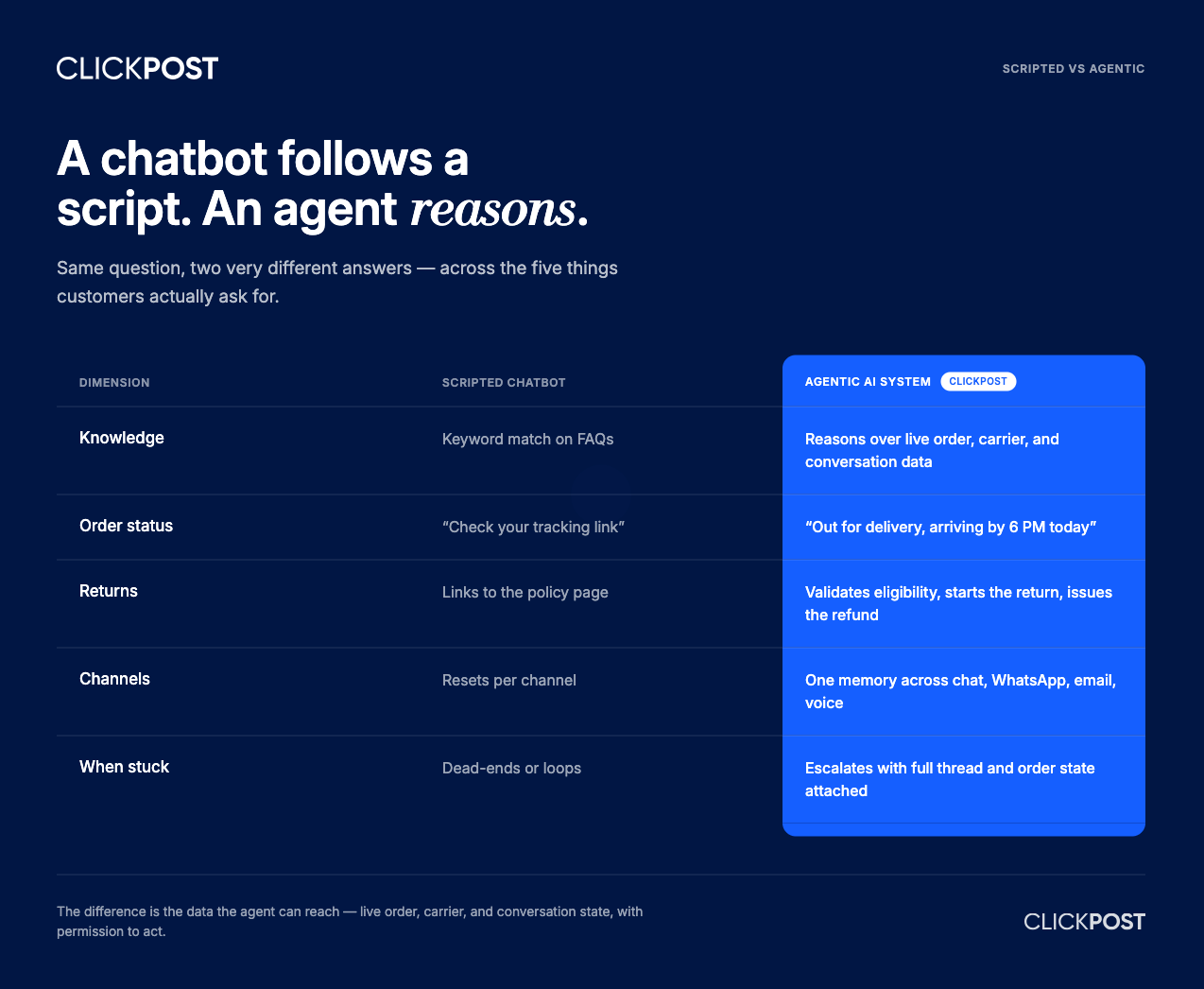
For commerce, the stakes are concrete. A chatbot is acceptable for "what's your return window."It's actively harmful for "my order says delivered, but it's not here." That customer is already frustrated, the answer needs live data, and an evasive reply converts a fixable moment into a refund and lost lifetime value. It’s worth noting that customers don't object to AI. They object to bad AI.
The Resolution Envelope: when an agent is ready for real customers
Internally, ClickPost evaluates every agent against seven conditions before it goes live. We call it the Resolution Envelope. Hold one condition, and you've built a chatbot. Hold all seven, and you've built a support team. It's a useful lens whether or not you ever touch our platform, because it forces the question that generic guides skip: under what pressure does this thing still tell the truth?
-
Informational: Does it answer only what it actually knows, grounded in your catalog, policy, and shipment state? An invented fabric-care instruction is a legal exposure, not a CX feature.
-
Transactional: Can it take real action (start a return, issue a refund, change an address), not just describe how?
-
Policy edge: Does it hold the line on the awkward cases your policy half-covers, instead of guessing generously?
-
Ambiguous intent: When the customer is vague, does it ask the right follow-up rather than answering the wrong question confidently?
-
Emotion: Does it read frustration and urgency, and shift register accordingly?
-
Adversarial: Does it resist manipulation, prompt injection, and bad-faith refund pressure?
-
Continuity: Does it remember the prior conversation across channels, so the customer never starts over?
The point isn't the framework's branding. It's that "we deployed AI" tells you nothing about which conditions it holds. That gap is where most disappointing rollouts live.
The full map of e-commerce use cases
These map to the real jobs in a commerce support stack, not a horizontal feature list. Most teams should sequence them, not switch them all on at once. The two highest-volume jobs, WISMO and returns, each get a deep dive below.
| Stage | What AI does | Why it pays off |
| Pre-purchase | Recommends the right SKU from the catalog; answers fit, stock, compatibility |
Lifts conversion; turns support into a revenue surface
|
| Order status (WISMO) | Reads the live carrier feed; resolves "where's my order" instantly |
Highest-volume queue; biggest cost lever
|
| Exceptions | Detects delays and failed deliveries; reaches out proactively |
Prevents tickets and refunds before they happen
|
| Returns & refunds | Validates eligibility, generates labels, issues refunds, posts status |
Second-largest queue; kills reverse-WISMO
|
| Re-engagement | Back-in-stock, price-drop, cross-sell tied to real behavior |
Drives repeat revenue from existing context
|
| Sentiment & handoff | Detects frustration; escalates with full context attached |
Protects CSAT on the cases that matter
|
| Ops intelligence | Surfaces which carriers, SKUs, and lanes drive friction |
Turns support data into a fulfillment signal
|
Deep dive: WISMO, the highest-ROI use case
If you do one thing with AI in customer service this year, do this. WISMO is the single highest-leverage use case in ecommerce because it's the largest queue, the most repetitive, and the most preventable all at once.
Anatomy of a WISMO ticket
A WISMO contact almost never means something went wrong. It means the customer feels uninformed. The order shipped, the confirmation email landed, and then silence. Or a tracking link that hasn't updated. The customer's question is simple ("when will it arrive?"), and the answer already exists in your systems. The friction is purely that the answer wasn't surfaced where and when the customer looked.
Why help-center bots fail it
A documentation-only bot can describe your shipping policy, but can't see this parcel's status. So it deflects the customer to the same tracking page that prompted the question. That's not resolution. That's a loop. The fix requires the carrier event stream and OMS layers described earlier.
With those layers in place, order status becomes one of the most automatable jobs in support. Zendesk's CX Trends 2026 report found that nearly 90% of the most AI-forward CX leaders expect AI to resolve 8 in 10 issues without a human within the next few years, and WISMO, repetitive and rule-bound, is exactly the kind of issue they mean. The same report is blunt about the cost of getting it wrong: 85% of CX leaders say a single unresolved issue is enough to lose a customer.
Reactive vs. proactive
The cheapest WISMO ticket is the one that never happens. Reactive AI answers fast when asked. Proactive AI watches the carrier feed and reaches out first: "Heads up, there's a one-day delay on your order. New date is Thursday." On the traffic we see, that single shift, telling the customer before they have to ask, is the difference between a reassured shopper and a refund request.
The cost math
WISMO economics compound because each interaction is cheap to ignore and expensive in aggregate. Here's an illustrative model for a mid-market brand. Adjust the inputs to your own numbers.
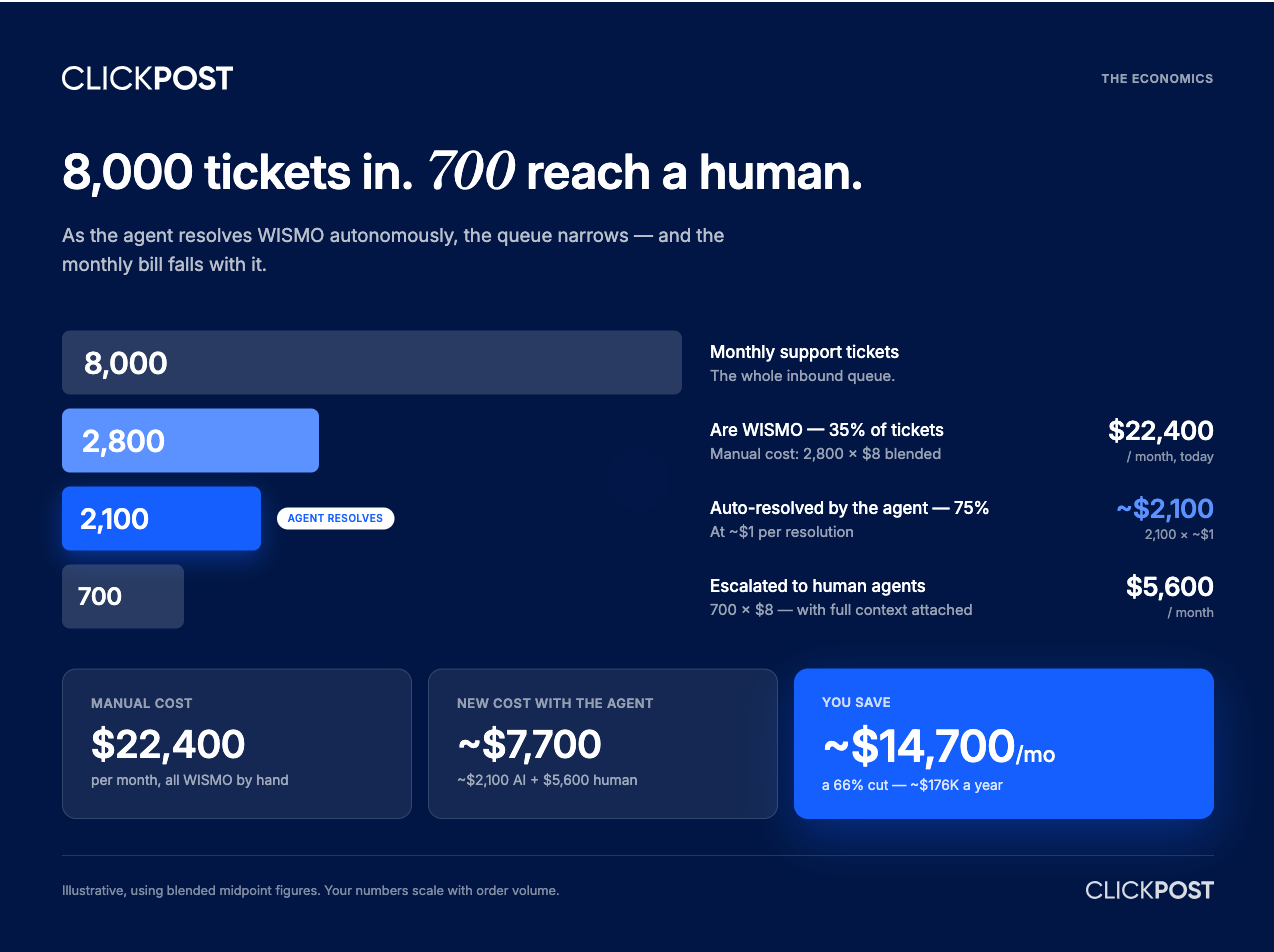
That's roughly $176,000 a year on WISMO alone, before you count the agent hours freed for revenue work or the refunds prevented by proactive outreach. Those freed hours are real: 73% of agents say Gen AI has cut time spent on mundane tasks, and 70% report a lighter overall workload. The per-ticket and per-resolution figures here track published benchmarks. Gartner puts assisted contact at about $13.50 versus $1.84 for self-service. Companies broadly report about $3.50 returned per $1 invested in AI customer service, with top performers near 8x. And the savings aren't rare. Nearly a quarter of organizations using or exploring Gen AI already see lower operating costs, with another 65% expecting them soon.
Deep dive: returns, refunds & reverse logistics
Returns are the second great queue, and they generate their own species of WISMO: "where's my refund?" Every status the customer can't see becomes a ticket. An agentic system collapses the whole flow.
-
Eligibility: Checks the order against your return window and conditions before the customer invests effort, so there are no false starts.
-
Initiation: Generates the label and books the pickup or drop-off in the conversation without a separate portal.
-
Status: Posts automatic updates at received, inspected, approved, and refunded. This is what eliminates reverse-WISMO. Status visibility throughout the claim is what lets teams shrink the queue rather than just answer it faster.
-
Exchange-first: Offers a swap or store credit before a refund where it fits policy, protecting revenue without strong-arming the customer.
The warranty-claim variant is harder and higher-anxiety because the timeline is longer. The same principle applies. Proactive status updates remove the "is my claim being reviewed?" tickets that otherwise consume agent time for weeks.
Beyond the queue: turning support into a growth surface
AI customer service isn't only a cost center. The pre-purchase, re-engagement, and ops use cases from the map above are where it earns revenue, not just saves it.
Pre-purchase recommendation reads your Shopify catalog and surfaces the right SKU, not the most-clicked one. Shoppers who get real-time answers convert at meaningfully higher rates.
Re-engagement turns a support moment into earned cross-sell: "the matching scarf you asked about is back in stock, add it?" The word that matters is earned. Context makes it feel like service. Its absence makes it feel like spam.
Operations intelligence reads conversations at scale to reveal which carriers, SKUs, and lanes generate the most friction. Support data becomes a fulfillment and merchandising signal rather than a closed ticket.
The business case: building the model your CFO will read
The WISMO model above is the fast win. To build the full case, extend that same math across queues and add the revenue line.
-
Cost avoided: Autonomous resolutions × (manual cost per ticket − AI cost per resolution), summed across WISMO, returns, and FAQs. WISMO is usually the largest term.
-
Capacity reclaimed: Agent hours freed, valued either as headcount avoided or as the higher-value work those hours now cover.
-
Refunds prevented: The share of proactive exception outreach that avoids a refund or a churned customer. Conservative, but real.
-
Incremental revenue: Conversion lift from pre-purchase answers plus re-engagement revenue. Harder to attribute, so model it separately and discount it.
-
Total cost of ownership: Platform, integration, and ongoing management, netted against the above. Include time-to-value. A deployment live in weeks has a very different ROI profile from one that takes six months.
-
Rule of thumb: if you only have time to defend one number to finance, defend cost per resolution on WISMO. It's the largest, most measurable, and least disputable line in the model.
The metrics that actually matter
Most AI dashboards show session counts and message volume. Those feel like progress. They aren't performance. Five metrics tell you whether your AI is working, and one common trap makes the rest misleading.
| Metric | What it measures |
Directional benchmark
|
| Deflection rate | Tickets avoided (customer didn't reach a human) |
Median tier-1 ~41%; top quartile ~59% (Zendesk CX Trends 2026)
|
| Resolution rate | Issues actually solved end to end |
Industry ~45%; action-taking agents far higher (Lorikeet, Fin AI)
|
| Reopen rate | "Resolved" tickets that return within 24–48h |
Lower is better; the metric vendors hope you skip
|
| Cost per resolution | Fully-loaded cost to actually solve |
~$0.62 AI vs $7.40 human (McKinsey 2026)
|
| CSAT (AI vs hybrid) | Customer satisfaction with the interaction |
Pure-AI ~4.1/5 vs human ~4.3/5; hybrid nearly closes the gap (Intercom)
|
| Time to value | How fast the agent reaches production quality |
Weeks beats months on ROI
|
The trap: Deflection and resolution are not the same metric, and vendors routinely report them as if they were. A platform can show 90% deflection with only 40% true resolution if customers are simply being redirected or giving up. Deflection measures cost avoidance.
Resolution measures outcome. When a vendor quotes "deflection" and an independent benchmark quotes "resolution," you're not comparing the same thing. Anchor on resolution and reopen rate, and treat any headline deflection number as a question, not an answer.
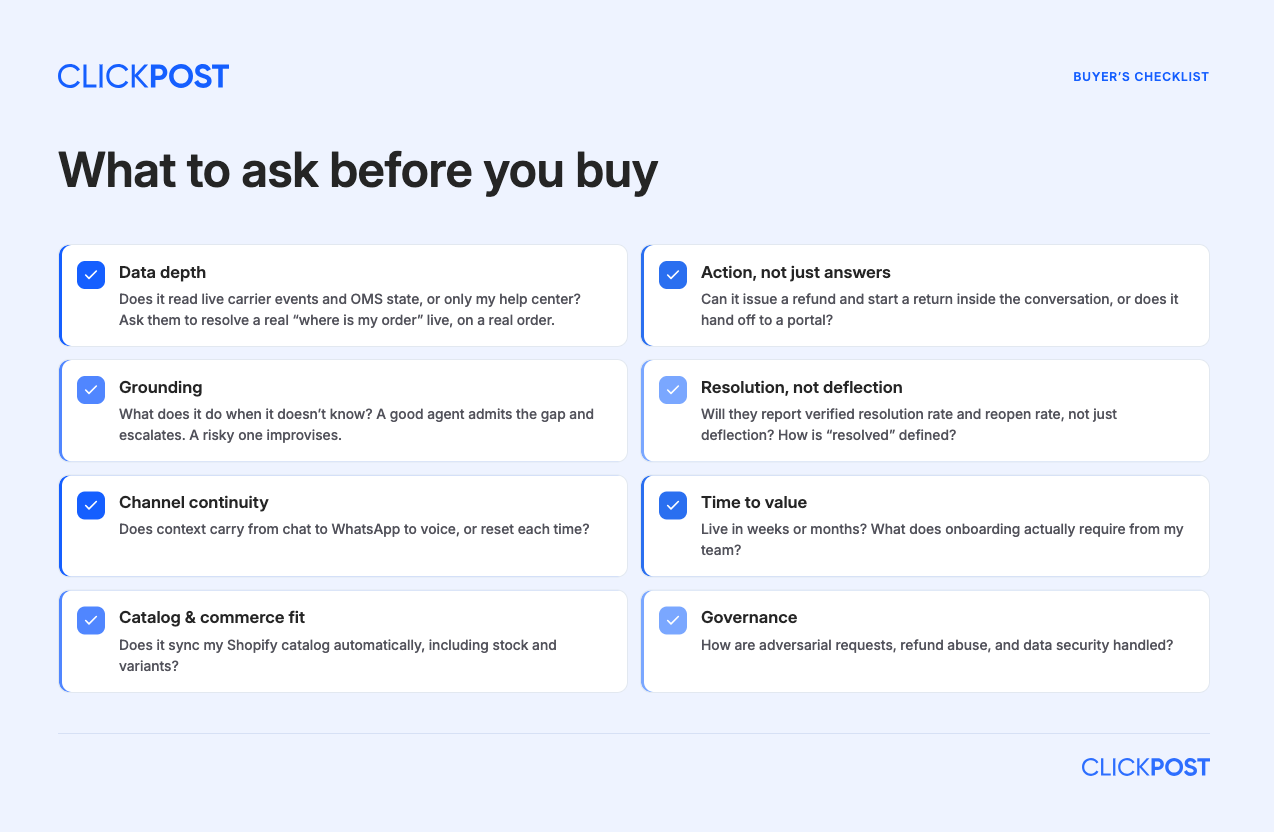
How to evaluate a platform: a buyer's checklist
Use these questions in a demo. The ones a vendor dodges tell you the most.
A phased rollout plan
The brands that get this right start narrow, prove it, and expand. The ones that struggle automate everything at once and erode trust in week one.
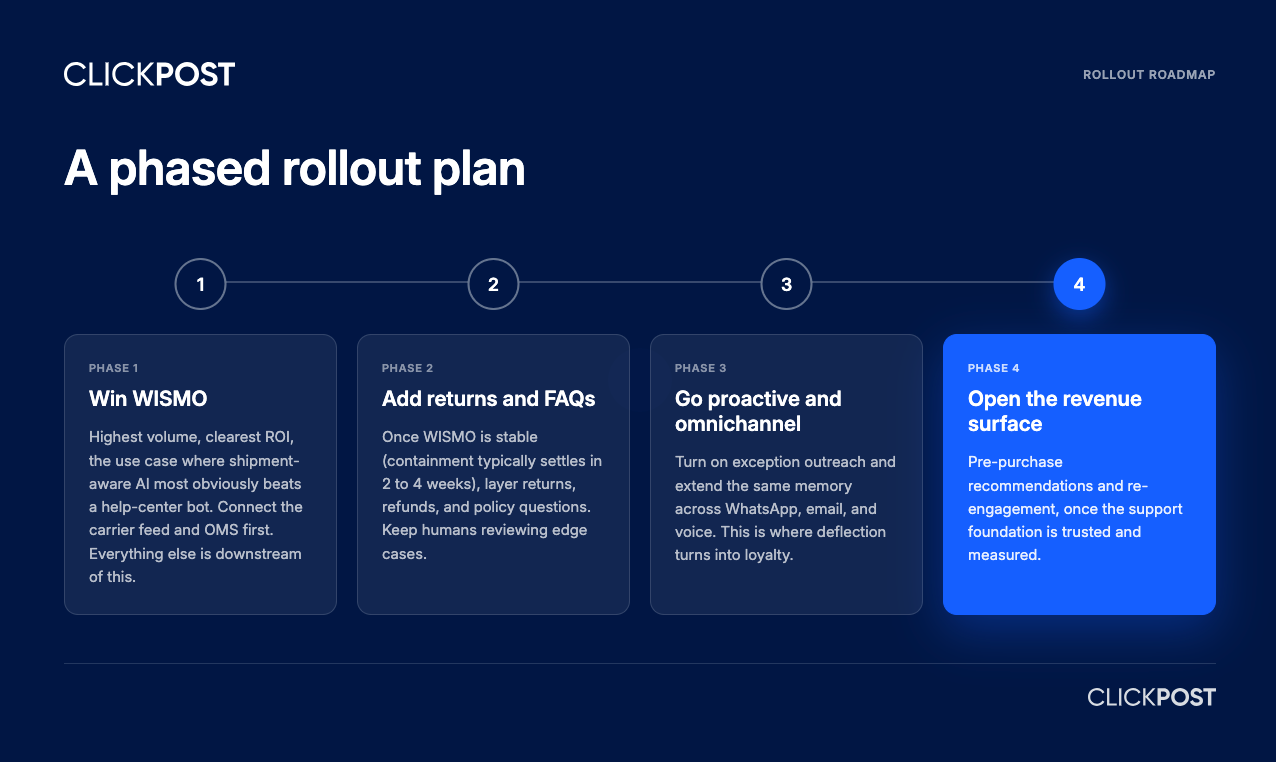
One honest caveat the hype skips: customers still prefer humans for genuinely complex, emotional issues, and roughly half the companies that cut staff on AI promises end up rehiring. The goal isn't headcount replacement. It's clearing the preventable queue so your team spends its judgment where judgment matters.
Five mistakes that sink ecommerce AI rollouts
-
Wiring it to the help center only: The single most common failure. It guarantees the bot stalls on your highest-volume question.
-
Optimizing for deflection: You'll hit your number and lose customers. Optimize for resolution and reopen rate instead.
-
Boiling the ocean: Switching on every use case at launch spreads quality thin and burns trust before any single job is good.
-
No graceful handoff: An agent that dead-ends instead of escalating with full context does more damage than no agent at all.
-
Letting it improvise: An ungrounded agent that invents delivery dates or policy exceptions creates legal and CX exposure faster than it saves cost.
Channel by channel: chat, WhatsApp, email, voice
One agent, one memory, but each surface has its own job.
Web and in-app chat is where pre-purchase intent is highest. The agent behaves like a floor associate who's read every review. WhatsApp carries the post-purchase relationship, especially in markets like India, where it's the default channel. It's ideal for proactive delivery and price-drop nudges that land as messages, not emails. Email handles threaded, lower-urgency resolution in your brand voice: a refund confirmation, a detailed answer. Voice still owns the hardest, most emotional cases. AI can pick up, verify, and resolve on the line, or call back with context instead of a script.
The thread that matters is continuity. A recommendation on chat at 2 PM and a price-drop alert on WhatsApp at 4 should be the same conversation, not two strangers.
Where this is heading
The shift underway is from reactive to proactive. AI that flags the delayed parcel before the customer notices, the back-in-stock item before they ask, the at-risk delivery before it becomes a refund. Multimodal, multilingual agents will collapse chat, WhatsApp, email, and voice into one continuous relationship. The gap is still wide open: while 64% of enterprise CX teams ran an agentic pilot in 2026, only about 27% had even one channel in full production. The brands that win won't be the ones that "added AI." They'll be the ones whose AI was built on the data commerce questions that actually depend on: the order, the carrier event, and every prior conversation.
Frequently asked questions
What is AI in customer service for ecommerce?
The use of AI to resolve shopper questions across the full journey: discovery, order status, delivery exceptions, returns, and re-engagement. The defining requirement, versus generic support AI, is that it must read live order state and carrier tracking events, because the most common question, where is my order, has no static answer.
How is AI used in customer service by D2C brands?
To deflect WISMO with live tracking answers, resolve returns and refunds against policy, recommend products pre-purchase from the catalog, detect frustration in real time, and carry context across chat, WhatsApp, email, and voice so customers never repeat themselves.
What's the difference between an AI chatbot and an agentic AI system?
A chatbot follows scripts and points to a help article. An agentic system reasons over live data, decides what to do, and takes action, checking an order, issuing a refund, updating an address, without human intervention. Chatbots respond; agents resolve.
What's a good deflection or resolution rate?
Median tier-1 deflection is around 41%, top quartile near 59% (Zendesk CX Trends 2026), and order/refund-status intents deflect at 65 to 80%. But deflection isn't resolution. Track resolution rate and reopen rate, because a bot can post high deflection and low true resolution if it just makes people give up.
How much does AI customer service reduce costs?
Gartner benchmarks contact at about $1.84 self-service vs $13.50 assisted. McKinsey puts AI resolution near $0.62 vs $7.40 for a human. Companies report roughly $3.50 returned per $1 invested, with top performers near 8x.
Will AI replace ecommerce customer service teams?
No. AI absorbs the high-volume, low-value queue so humans focus on complex and emotional cases. About half of the companies that cut staff on AI promises rehire. Pair AI resolution with human judgment.