%20%20-%20Menu.svg)







In this blog
TL;DR
AI agent assist is software that supports human support agents in real time by drafting replies, surfacing knowledge base content, and flagging customer sentiment without removing human control.
-
Productivity research from the Quarterly Journal of Economics found that AI agent assistance increased issue resolution rates by roughly 15% per hour.
-
Newer agents benefit most, with lower-skilled reps improving up to 34%, compressing months of ramp time into weeks.
-
Agent assist fails on WISMO tickets because carrier tracking data lives outside the knowledge base, leading to confidently wrong replies.
-
Agentic systems grounded in live shipment data resolve logistics tickets where assist tools can only paraphrase policy articles.
-
Ecommerce brands running high post-purchase volume need data-connected agents, not faster drafts, because logistics questions require order-state truth.
The Queue Problem Nobody Talks About
Picture a typical afternoon in an ecommerce support queue. A rep has four chats open. One customer wants a size recommendation. One is asking about the return window. Two are asking where their package is.
The size question and the policy question can be answered from the help center. The other two are not, and those are the ones eating the clock.
AI agent assist is the category of tooling built to take the pressure off exactly that moment. It runs quietly in the background of a live conversation and offers the agent something useful: a drafted reply, a relevant article, a read on the customer's sentiment, so they can respond without breaking stride. It is a genuinely good idea, and the data backs it up. It is also widely misunderstood because the demos rarely show you where it stops working.
This piece covers what an AI agent assist actually does, where it earns its keep, and the specific failure mode that matters most if you are running support for a D2C or retail brand.
What AI Agent Assist Actually Is
AI agent assist is software that supports a human agent during a live customer conversation. It suggests responses, surfaces knowledge, and flags issues in real time, without taking over the conversation. The human stays in control. The AI just makes them faster and more consistent.
Think of it as a copilot, not an autopilot. When a customer message comes in, the assist layer reads it. It might draft a reply in your brand voice, pull the relevant help article so the rep does not have to dig for it, detect that the customer is frustrated, or flag the ticket that needs escalation. The agent reviews, edits, and sends. Nothing goes out without a human hand on it.
That last point matters more than it sounds. Agent Assist recommends. It does not resolve. That distinction sounds small, but it has significant consequences in practice, which we will get to shortly.
It is also worth separating agent assist from a customer-facing chatbot. A chatbot talks directly to the shopper. Agent Assist talks to your team. Many modern support stacks run both, which is why the lines get blurry. If you're evaluating the broader landscape, our roundups of customer support and help desk tools and Shopify customer service apps map out where each layer fits.
Why Support Teams Use AI Agent Assist
The case for agent assist is real, and the most credible evidence comes from outside the vendor blogosphere. A study published in the Quarterly Journal of Economics found that giving customer support agents access to a generative AI assistant increased their productivity by roughly 15%, measured as issues resolved per hour.
But the headline number is not the most interesting part. The gains were lopsided. Newer, lower-skilled agents improved by as much as 34 percent, while the most experienced agents barely moved. The assist layer was not making good agents better. It was making new agents perform like the good ones faster.
Key insight from the research: Agent Assist's real value isn't speed. It's compressing the ramp time it takes a new hire to sound like a veteran. Agents with two months of experience began performing like agents with six months, without any additional training time.
That reframes what you are actually buying. If your team is stable and senior, the upside is modest. If you are scaling headcount, onboarding through peak season, or running a high-churn support floor, the assist layer is paying down your training cost in real time.
Here is where it concretely helps:
-
Faster replies on routine tickets: The draft and the relevant article appear as the agent reads the message, eliminating manual lookups.
-
Consistency across the floor: Suggestions drawn from approved content mean ten agents give one answer, not ten variations.
-
A shorter learning curve: New hires get real-time coaching on tone and policy instead of memorizing a wiki before they can help anyone.
-
More attention to the human part: With lookups handled in the background, agents can focus on the conversation rather than hunting for the right answer.
What AI Agent Assist Does Day to Day
Strip away the branding, and most agent assist tools do a similar set of things inside a live conversation:
-
Draft on-brand replies: It reads the incoming message and proposes a response that matches your tone and approved language, ready to edit or send.
-
Surfaces knowledge. It searches your connected help center, FAQs, and policy docs and pushes the most relevant snippet into the agent's view, with no tab-switching.
-
Reads sentiment: It flags when a customer is frustrated or anxious, so the agent can adjust tone before things escalate.
-
Improvises on novel questions: When there is no exact match in the docs, it generates a best-effort draft from related content for the agent to review and edit.
That last capability is where the cracks start to show. Generating a best-effort draft when there is no exact answer is a polite way of describing a confident guess. For a question about your refund policy, a confident guess is usually fine since the policy is in the docs. For a question about a specific shipment, a confident guess is a liability.
Where Agent Assist Breaks Down for Ecommerce
The heaviest part of an ecommerce support queue is not product questions or policy lookups. It is post-purchase logistics: order status, delivery failures, and refund timelines. And this is precisely where assist tools run out of road, because none of those answers live in an article.
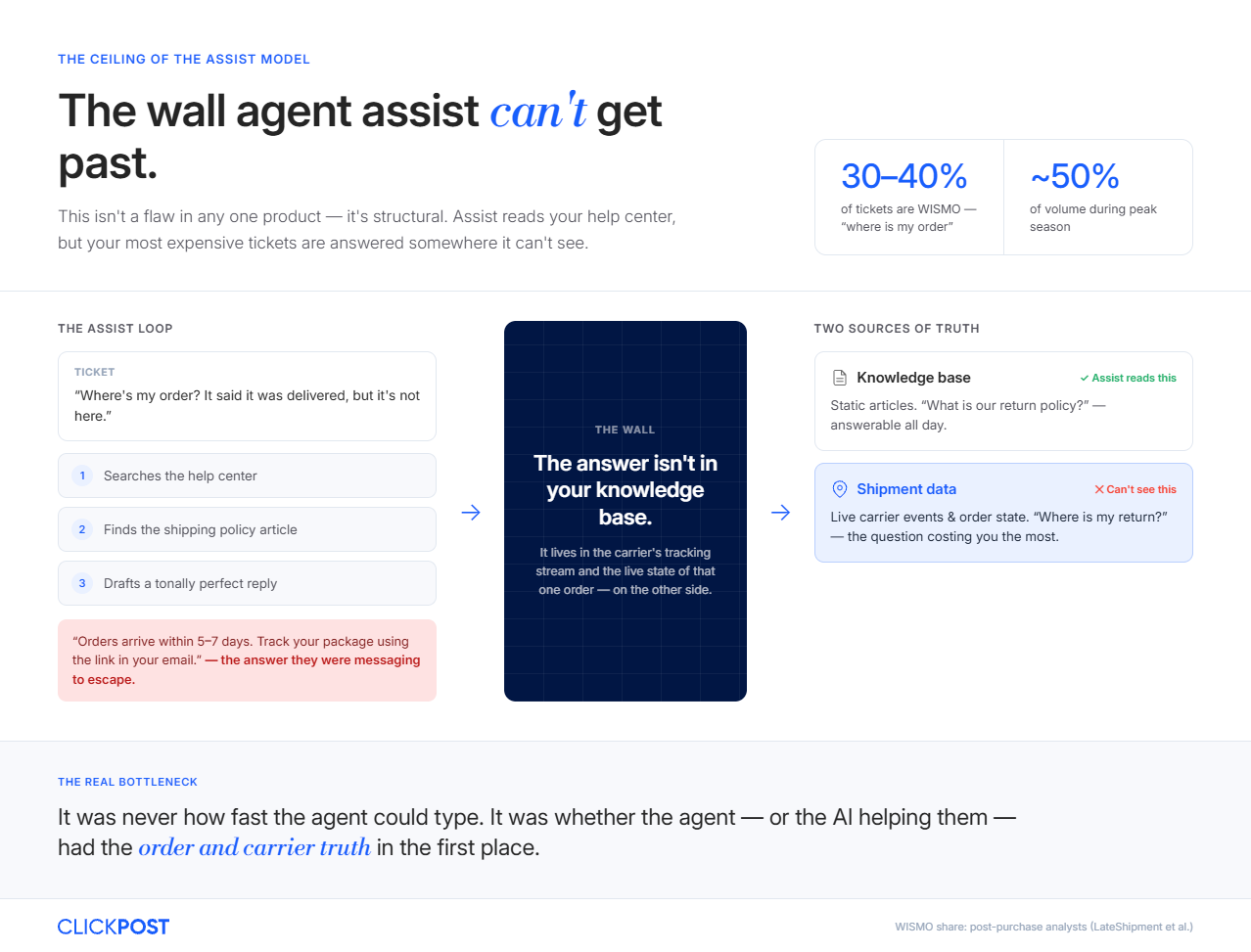
WISMO, which stands for “Where is my order”, is consistently the single largest ticket category for most online brands. During peak seasons, it regularly accounts for more than half the inbound queue. Stack returns status, refund timing, and delivery exceptions on top of that, and you are looking at the majority of your volume being questions about the physical state of a parcel somewhere in a carrier network.
Now consider what an agent assist tool actually does when one of those tickets lands.
A customer writes in: "It says delivered, but there is nothing here." The assist layer reads the message, searches the knowledge base, finds the shipping policy article, and drafts: "Orders typically arrive within 5 to 7 business days. You can track your package using the link in your confirmation email."
That customer already clicked the tracking link. That is why they are writing to you. The tool just handed your agent a polished version of the answer the customer was already trying to get past.
This is not a configuration problem or a content gap you can close by writing better FAQs. It is structural. Agent Assist reads your knowledge base. The answer to that ticket is not in your knowledge base. It is in the carrier's tracking event stream. Whether the package was scanned at a hub this morning, whether the courier marked it delivered to a neighbor, or whether it is sitting in a delivery exception with no resolution action triggered. A help article cannot surface any of that. Only a system with live access to shipment data can.
The cost of this gap is not one bad reply. It is every WISMO ticket, every missed-delivery escalation, every "where is my refund" that gets a policy quote instead of a status. These are your highest-volume tickets, handled slowest, because the tool you gave your agents was built for a different kind of question entirely.
Assist vs. Agentic: The Distinction That Actually Matters
The category is splitting, and it is worth getting the language right because vendors use these terms loosely. The table below is the clearest way to see the difference.
| AI Agent Assist (Copilot) |
Agentic AI (Resolver)
|
|
| What it does | Suggests a reply for a human agent to review and send |
Reads the order, takes the action, and resolves the ticket end-to-end
|
| Source of truth | Help center, FAQs, approved policy docs |
Live order state, carrier events, conversation history
|
| Handles WISMO? | No — guesses from policy content |
Yes — pulls actual shipment status
|
| Human role | Reviews and approves every reply |
Steps in on edge cases and escalations
|
| Best for | Speeding up agents on routine, policy-based tickets |
Deflecting high-volume, data-dependent tickets automatically
|
Assist is the right tool when your goal is to make a human faster at answering questions that the human could already answer from existing documentation. An agentic system is what you need when the question requires knowledge of the order, the shipment, or prior conversations that no article contains.
We learned about building support automation in logistics. The first version of any AI support layer that only reads text fails on exactly the tickets that matter most, because logistics questions are data questions. That is the premise behind how we built Parth, our AI agent for resolving failed-delivery (NDR) cases, not by drafting better apologies for stuck packages, but by reading the carrier event and acting on it. An apology does not move a parcel. Knowing why it stopped does.
The deeper point: an AI agent is only as trustworthy as the truth it is grounded in. An assist tool grounded in your help center will confidently answer questions your help center cannot actually answer. A system grounded in live delivery data answers from the shipment itself. One paraphrases. The other knows.
How to Start with AI Agent Assist
If your support volume skews toward pre-sale and policy questions, sizing, product fit, return rules, and account issues, a straightforward assist tool is a fast, low-risk win. Most follow the same setup pattern:
-
Connect it to your help desk: Good tools layer onto Zendesk, Intercom, Gorgias, or Gmail without requiring a migration, often via a browser extension.
-
Point it at your knowledge: Feed it your FAQs, policy pages, product documentation, and return instructions. The quality of its suggestions is capped by the quality of what you connect.
-
Pilot with a few agents: Turn it on for a small group in live chat and email before a full rollout. Watch where the suggestions land and where they miss.
-
Watch the misses, not the hits: The tickets where the suggestion was useless are your roadmap. If most of them are post-purchase order status, refund timing, or delivery problems, that is your signal that assistance alone will not carry the queue.
If those misses are mostly "where is my order," that is not a content gap you can close by writing more articles. It is a data gap. ClickPost grounds support answers in live carrier events and order state, so the hardest tickets resolve from the truth, not a guess.
See how clickPost agentic support works →
Tips to Get Real Value from AI Agent Assist
Feed it rich, current content
Link your help articles, FAQs, pricing tables, and policy docs, and review them on a regular schedule. Stale content produces confidently wrong suggestions, which is the worst possible output because it is wrong and persuasive. Assign an owner to each content area and review at least monthly.
Treat the AI as a co-pilot, not a script
The productivity research is clear: gains come from agents using judgment on top of suggestions, editing, and freely dismissing, not from unthinkingly sending whatever appears. Make it explicit to your team that overriding the AI is encouraged. It is not a failure to question a suggestion; it is the whole point.
Separate the answerable from the unanswerable.
Audit a week of tickets and split them into two groups: those that were answerable from your knowledge base, and those that needed live order or shipment data. Assist tools are in the first group. The second needs a system wired into your logistics data.
Proactive delivery notifications and self-service tracking also deflect a large share of WISMO before it ever becomes a ticket. When customers can see exactly where their order is without reaching out, that is a contact you never have to handle.
Fix the cause, not just the reply speed
Faster answers to WISMO are good. A post-purchase experience that prevents the question in the first place is better. Accurate delivery dates at checkout, branded tracking pages, and proactive alerts on delivery exceptions reduce inbound volume at the source, which is more valuable than getting faster at handling a flood you did not need to create.
Frequently Asked Questions
What is AI agent assist?
AI agent assist is software that helps a human support agent during a live conversation by suggesting replies, surfacing relevant knowledge base content, and flagging tone or escalation signals. The human stays in control and sends every response. The AI makes them faster and more consistent. It works behind the scenes for the agent, not directly with the customer.
What's the difference between an AI agent assist and an AI chatbot?
An AI chatbot talks directly to the customer and may resolve queries on its own. An AI agent assists in talks with your support team and works behind the scenes to help a human reply more effectively and faster. Many support stacks run both: a bot handling first contact and an assist layer helping agents on escalated or more complex tickets.
Does AI agent assistance work for ecommerce WISMO questions?
Not on its own. WISMO questions require live carrier tracking data and the specific state of an order, information that lives in your shipping platform, not your help center. An assist tool that only reads knowledge base content will return your generic shipping policy, which the customer has almost certainly already seen. Properly resolving WISMO requires a system connected to live shipment data.
Is AI agent assist the same as agentic AI?
No. Agent assist suggests a reply for a human to review and send. Agentic AI can read the order, take action, and resolve the ticket end-to-end, with humans stepping in for edge cases. Assist is grounded in your documentation. An agentic system is grounded in live order and carrier data. The practical difference shows up most clearly on data-dependent tickets like order status and delivery exceptions.
How much does an AI agent actually improve productivity?
Peer-reviewed research across more than 5,000 support agents found a 14 to 15 percent increase in issues resolved per hour, with the largest gains concentrated among newer, less experienced agents, who improved by as much as 34 percent, and had minimal impact on veterans. The takeaway is that the strongest ROI comes when you are scaling headcount or onboarding a team, not when your floor is already senior and well-trained.
How do I know if I need agent assistance or an agentic system?
Audit a week of tickets. If most are answerable from your help center, policy questions, product details, and account issues, agent assist will lift your team meaningfully. If a large share of post-purchase logistics questions are around order status, returns, refunds, or failed deliveries, you will hit the assist ceiling quickly and need a system wired into your shipment data.